


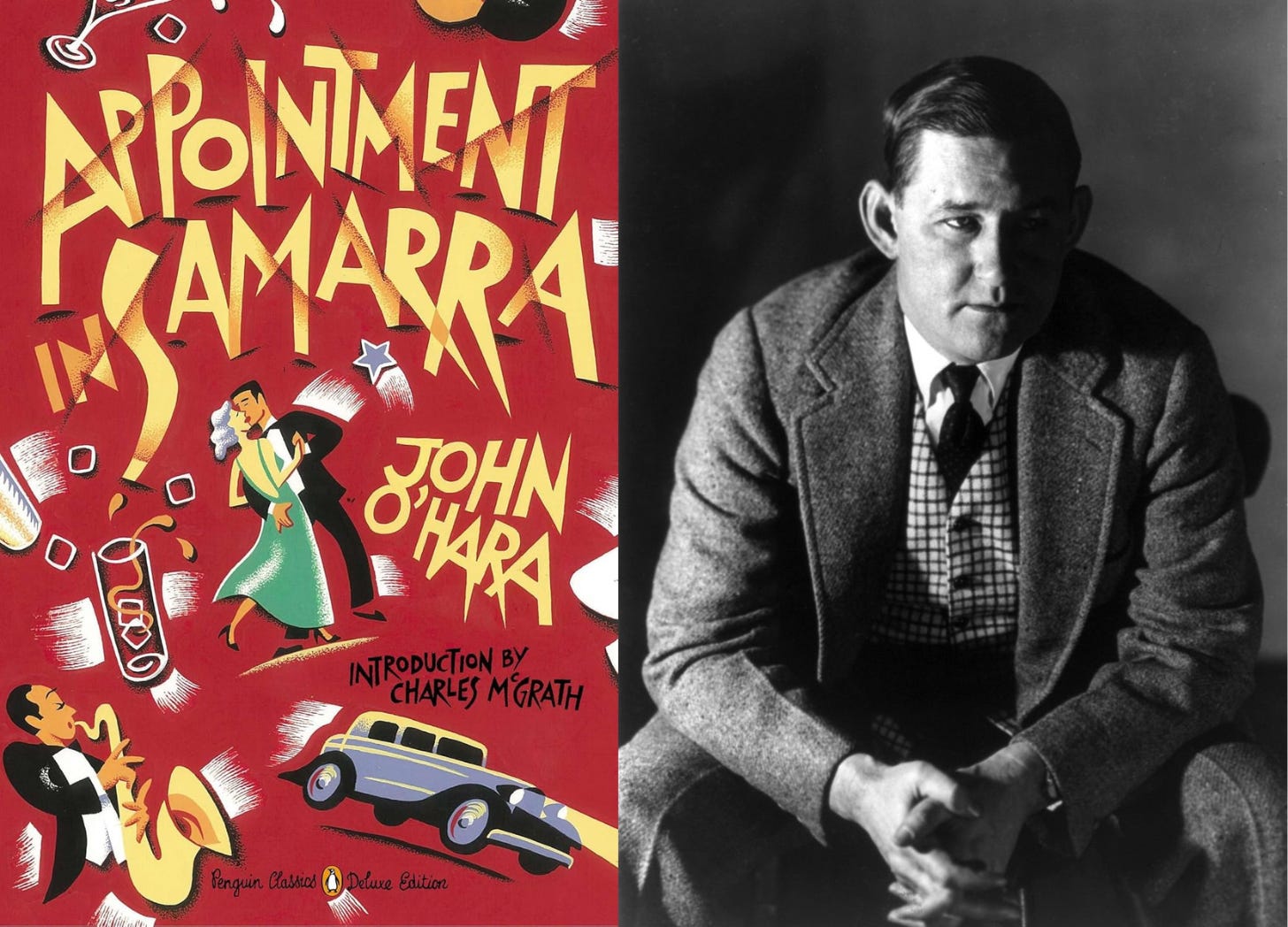
Appointment in Samarra is an unfortunate title for a novel that’s about nothing that the title might suggest, until you read the epigraph, from the play Sheppey by W. Somerset Maugham, and you realize that the title really means Appointment with Death. The main character, Julian English, the ne’er-do-well son of a rich, morally-uptight, hack of a small-town doctor, is a disappointment to his parents, and gets deeper and deeper into a hole, through his own doing—through alcoholism, philandering, and fiscal profligacy—until he brings on his demise. “If ever there was a man in a jam, he was it,” writes the author, John O’Hara.
Julian’s wife, Caroline Walker, the belle of her generation in Gibbsville, PA, falls for Julian when he’s young and charming enough to gloss over his rakish ways. He is a man who, “as good as he had been [with women], is not wholly trusted and liked by men.” The story starts with Julian and Caroline settled into their life, fish of the highest possible pedigree in this small pond of a town. Julian runs the local Cadillac dealership, badly, but thanks to connections, does well enough, and spends his weekends at the country club, exercising his clout over social climbers. Caroline is happy to be on his arm, and hopes for children, but wants Julian to stop getting drunk and embarrassing them.
The book immerses us in small-town, East Coast America almost a century ago. The story ends just after Christmas 1930, at the tail-end of Prohibition. O’Hara basically admitted that, to write the book, he drew on real experience, growing up in WASPish Pottsville, PA. His father, the town’s Irish Catholic doctor, died young, plunging the family into poverty. Catholics are second-class citizens in the book, although, unlike Jews, they’re admitted to the country club, and ultimately topple Julian, after he throws a drink into the face of a rich, blowhard Catholic who has a crush his wife. Neither WASPs nor Catholics, if they’re wealthy, come off well in the book.
The novel’s 270 pages make for very juicy reading. The exposition is gossipy. You learn these stuffy people’s secrets. When drunk, they get up to mischief. When the book came out in 1934, it got criticized for being racy. It has a couple of very sexy scenes. The dialogue is superb. O’Hara—who published over 400 short stories, and more stories in The New Yorker than any other writer—had a stupendous ear and actually championed dialogue as the most effective literary technique for “produc[ing] true characters.” There’s a scene at a speakeasy, where O’Hara has all these different characters of different social classes, and in different states of inebriation, talking back and forth to each other. It’s unparalleled. And, it moves the story along.
The book switches masterfully between omniscient narrator and the perspective of different principal characters, Julian, Caroline, and Al Grecco, a small-time mobster, who supplies the liquor to these upscale lushes. Perhaps O’Hara’s characterization of Caroline is as impressive as that of Julian. She’s tolerant, intelligent, and feels deeply, especially in love. We see her with three or four suitors before Julian.
Some false notes pop up near the end, but minor stuff. Something cool: the characters mention F. Scott Fitzgerald and Ernest Hemingway, both of whom ended up liking the book. Hemingway loved it.
O’Hara wrote Appointment in Samarra, his debut novel, at twenty-eight, and it might be his greatest single achievement—at least stylistically—although he wrote seventeen or eighteen novels, a few of which garnered big awards. He finished it in six months, writing two to three hours a night, five nights a week, in the Pickwick Arms Hotel in Manhattan, while hanging out in saloons and having tea with Dorothy Parker, another New Yorker legend, during the day. He first envisioned the book as four separate short stories, each one revolving around a different character, but aborted that idea, and started over. Good decision.
Appointment in Samarra is literature at its very best, without being heavy reading at all. Like almost all great books, a film could never do it justice; too many scrumptious stories packed into the exposition. To sum it up in one phrase: It’s the story of a spoiled-child-turned-careless-man who suffocates under the stigma of increasingly appalling social blunders. It’s timeless, I’m telling you.
I love this book. Brutal